
Sayart.net - French Photographer Marie Quéau Unveils ′Fury′ Exhibition Exploring Extreme Physical and Mental States

  • December 10, 2025 (Wed)

French Photographer Marie Quéau Unveils 'Fury' Exhibition Exploring Extreme Physical and Mental States

Sayart / Published December 1, 2025 10:52 AM
  • -
  • +
  • print

French photographer Marie Quéau has unveiled her latest project "Fury" at LE BAL in Paris, a comprehensive work developed over the past two years as part of the 5th edition of the LE BAL/ADAGP Young Creation Prize, for which she was awarded the top honor. The exhibition presents an immersive exploration of extreme physical and mental states through a mysterious blend of black-and-white photographs, wallpapers, videograms, and projections.

Quéau's artistic process begins with research notebooks that overflow with obsessively collected images from secondhand books and magazines related to history, arts, and natural sciences, combined with her own reconnaissance photographs. These fragments are assembled, glued, and intertwined on pages to create a visual background noise that accompanies her in developing scenarios. This method allows her to shape worlds from fragments of reality, creating works that exist at the border between documentary and fiction.

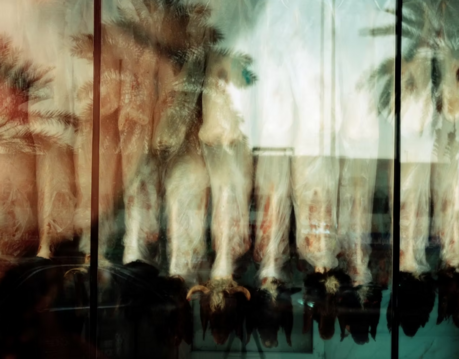
The "Fury" exhibition invites visitors into an unknown universe that evokes the atmosphere of the film "Alien," specifically referencing the planet Fury-161 where Ripley's ship crashes in the third installment. Visitors encounter a mysterious mixture of masked faces, silhouettes dressed in motion capture suits, body parts covered in gel, and flames arranged on the floor as the only colored images. These diverse works are displayed in semi-darkness without explanatory labels, forming a complete organism that creates an immersive experience filled with curiosity mixed with unease.

A projection at the exhibition entrance provides crucial context for understanding the work. "Fury" references "fury rooms" – spaces that anyone can reserve to destroy objects in a cathartic gesture. The video alternates between jerky excerpts from surveillance footage of these rooms and moments of weightlessness where inert bodies float in water, regulating their breath to the hypnotic rhythm of a voice counting minutes. Through fury rooms, static apnea, and stuntmen covered in fire-retardant gel crossing through flames, Quéau explores the extreme states to which the body can submit itself.

The relationship with the body constitutes a central axis of Quéau's practice, born from her commissioned work for sports magazines but now shifted toward a decidedly artistic approach. "I wanted to highlight a philosophy of the body, something that touches on limits, from a fictional point of view rather than a biological study of sport," she explains. A solarized image of a body at the edge of a window embodies the notion of threshold that runs through her work – the tension of wavering, the moment when the body reaches its limit and only the mind remains as a refuge for taming chaos, risk, and fear.

The tight framing in her photographs accentuates the simultaneously suffocating and soothing impression of withdrawal into oneself, echoing what she describes as "a state of absence from the world." In the meanders of "Fury," visitors themselves seem to find themselves holding their breath, perhaps reflecting the experience of our contemporary world. The exhibition is accompanied by a publication created in collaboration with graphic designer Roger Willems from Roma Publications, featuring the photographer's taste for accumulation and precise attention to the materiality of images through paper brightness effects.

Historian Guillaume Blanc-Marianne contributes a text that offers a fine exploration of the "poetic enigma" that constitutes this work. As the author notes, "Fury" is above all Marie Quéau's world, and therein lies its entire beauty. The exhibition demonstrates how contemporary art can address universal themes of human limits and resilience through deeply personal yet universally resonant imagery.

French photographer Marie Quéau has unveiled her latest project "Fury" at LE BAL in Paris, a comprehensive work developed over the past two years as part of the 5th edition of the LE BAL/ADAGP Young Creation Prize, for which she was awarded the top honor. The exhibition presents an immersive exploration of extreme physical and mental states through a mysterious blend of black-and-white photographs, wallpapers, videograms, and projections.

Quéau's artistic process begins with research notebooks that overflow with obsessively collected images from secondhand books and magazines related to history, arts, and natural sciences, combined with her own reconnaissance photographs. These fragments are assembled, glued, and intertwined on pages to create a visual background noise that accompanies her in developing scenarios. This method allows her to shape worlds from fragments of reality, creating works that exist at the border between documentary and fiction.

The "Fury" exhibition invites visitors into an unknown universe that evokes the atmosphere of the film "Alien," specifically referencing the planet Fury-161 where Ripley's ship crashes in the third installment. Visitors encounter a mysterious mixture of masked faces, silhouettes dressed in motion capture suits, body parts covered in gel, and flames arranged on the floor as the only colored images. These diverse works are displayed in semi-darkness without explanatory labels, forming a complete organism that creates an immersive experience filled with curiosity mixed with unease.

A projection at the exhibition entrance provides crucial context for understanding the work. "Fury" references "fury rooms" – spaces that anyone can reserve to destroy objects in a cathartic gesture. The video alternates between jerky excerpts from surveillance footage of these rooms and moments of weightlessness where inert bodies float in water, regulating their breath to the hypnotic rhythm of a voice counting minutes. Through fury rooms, static apnea, and stuntmen covered in fire-retardant gel crossing through flames, Quéau explores the extreme states to which the body can submit itself.

The relationship with the body constitutes a central axis of Quéau's practice, born from her commissioned work for sports magazines but now shifted toward a decidedly artistic approach. "I wanted to highlight a philosophy of the body, something that touches on limits, from a fictional point of view rather than a biological study of sport," she explains. A solarized image of a body at the edge of a window embodies the notion of threshold that runs through her work – the tension of wavering, the moment when the body reaches its limit and only the mind remains as a refuge for taming chaos, risk, and fear.

The tight framing in her photographs accentuates the simultaneously suffocating and soothing impression of withdrawal into oneself, echoing what she describes as "a state of absence from the world." In the meanders of "Fury," visitors themselves seem to find themselves holding their breath, perhaps reflecting the experience of our contemporary world. The exhibition is accompanied by a publication created in collaboration with graphic designer Roger Willems from Roma Publications, featuring the photographer's taste for accumulation and precise attention to the materiality of images through paper brightness effects.

Historian Guillaume Blanc-Marianne contributes a text that offers a fine exploration of the "poetic enigma" that constitutes this work. As the author notes, "Fury" is above all Marie Quéau's world, and therein lies its entire beauty. The exhibition demonstrates how contemporary art can address universal themes of human limits and resilience through deeply personal yet universally resonant imagery.
WEEKLY HOTISSUE