An art exhibition in Daegu featuring satirical works critical of former President Yoon Suk Yeol has been partially shut down following an order from the district chief, reigniting debate over artistic freedom and administrative censorship in South Korea.
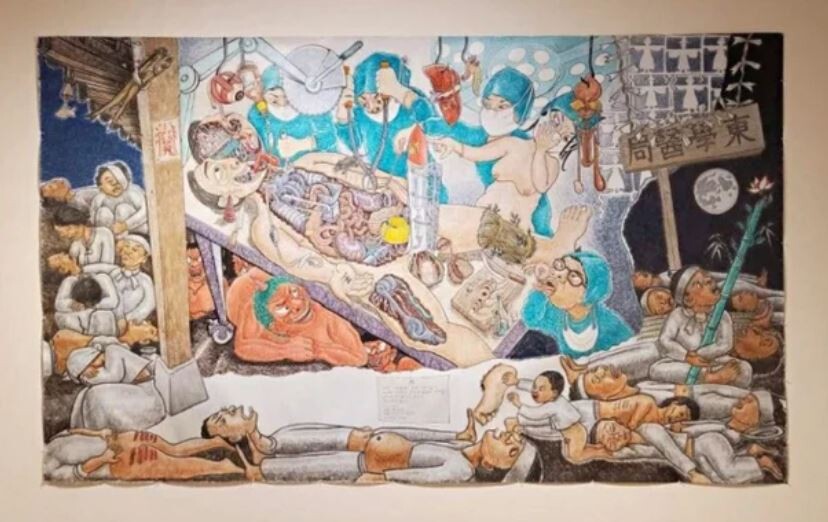
The exhibition, Art for the Future: Daegu, Art, Answer the Zeitgeist, opened Thursday at the district-run Bongsan Cultural Center, organized by the Daekyung Art Research Institute (DARI). Controversy centered on three paintings by artist Hong Sung-dam that employ political satire to comment on recent Korean history and contemporary governance.
"Donghak-uiguk" by artist Hong Sung-dam (Courtesy of Daekyung Art Research Institute)
After initial requests by the venue to remove the works were rejected, the exhibition briefly proceeded under a pledge placing responsibility on the artists. However, Jung-gu District Chief Ryu Kyu-ha later ordered the closure of the gallery displaying the works, citing regulations that prohibit political content in the center.
While two other galleries remain open, local artists argue the move constitutes undue censorship. DARI criticized the decision as an administrative overreach that deprives both artists and citizens of cultural expression, warning of a chilling effect on critical art in public spaces.
SayArt.net Kelly.K pittou8181@gmail.com
An art exhibition in Daegu featuring satirical works critical of former President Yoon Suk Yeol has been partially shut down following an order from the district chief, reigniting debate over artistic freedom and administrative censorship in South Korea.
The exhibition, Art for the Future: Daegu, Art, Answer the Zeitgeist, opened Thursday at the district-run Bongsan Cultural Center, organized by the Daekyung Art Research Institute (DARI). Controversy centered on three paintings by artist Hong Sung-dam that employ political satire to comment on recent Korean history and contemporary governance.
"Donghak-uiguk" by artist Hong Sung-dam (Courtesy of Daekyung Art Research Institute)
After initial requests by the venue to remove the works were rejected, the exhibition briefly proceeded under a pledge placing responsibility on the artists. However, Jung-gu District Chief Ryu Kyu-ha later ordered the closure of the gallery displaying the works, citing regulations that prohibit political content in the center.
While two other galleries remain open, local artists argue the move constitutes undue censorship. DARI criticized the decision as an administrative overreach that deprives both artists and citizens of cultural expression, warning of a chilling effect on critical art in public spaces.
Warning: Trying to access array offset on value of type bool in /home/sayart/public_html/_libs/smarty/templates_c/103e99f6d7d08ee6b6541efd32c0ef2f33076acc_0.file.news_3t_view.tpl.php on line 56
Warning: Trying to access array offset on value of type bool in /home/sayart/public_html/_libs/smarty/templates_c/103e99f6d7d08ee6b6541efd32c0ef2f33076acc_0.file.news_3t_view.tpl.php on line 59