Nam June Paik’s “Robot K-456” Has Returned to the Stage, Decades After Its Last Steps
Sharon Jung / Published February 3, 2026 04:04 AM
Sharon Jung
On a quiet winter afternoon in Yongin, Gyeonggi Province, a legendary robot has taken its first steps again after decades of silence. With its stiff, mechanical limbs and a silver foil hat, it appeared less like a vision of the future than a relic from an earlier era of science fiction.
Yet the robot carried a message.
“Robot K-456” (1964/1996), created by pioneering video artist Nam June Paik (1932–2006), was revived last month as part of a 50-minute multimedia performance at the Nam June Paik Art Center. The performance, staged in late January, marked the robot’s first public movement in decades and has since drawn renewed attention to Paik’s vision of technology and humanity.
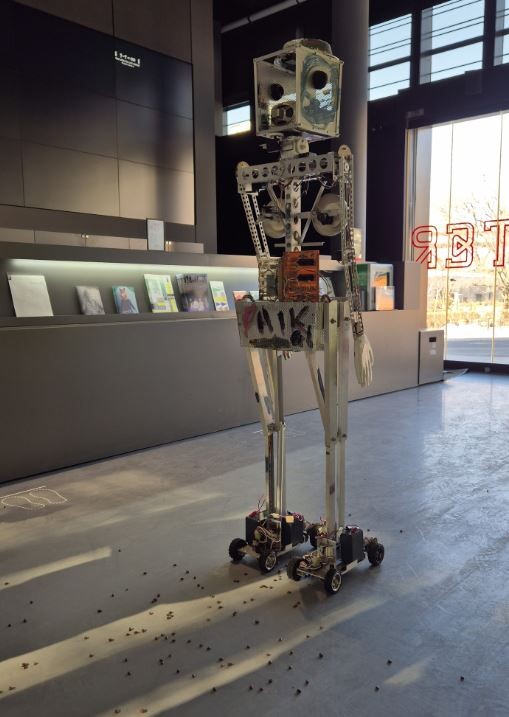
“Robot K-456” (1964/1996) by Nam June Paik marches while scattering coffee beans at the Nam June Paik Art Center in Yongin, Gyeonggi, on Jan. 27. [KWON KEUN-YOUNG]
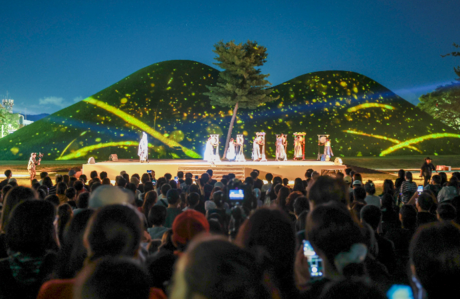
Titled “Ghost Theatre X Robot K-456: The Circuit Turned Back On,” the work was conceived by media artist Kwon Byung-jun and featured a cast of acrobatic robots performing alongside human operators. During the performance, robots unfolded fans, bowed in slow, meditative gestures, waved their arms in dance and tap-danced across a steel platform.
As the atmosphere reached its climax, a curtain styled as a massive cathode-ray tube television lifted to reveal the main act: “Robot K-456.”
Standing 1.85 meters tall, the human-sized robot gestured as if delivering a speech and lifted its foil-like hat while a speaker in its mouth blared a recording from U.S. President John F. Kennedy’s 1961 inauguration address: “Ask not what your country can do for you — ask what you can do for your country.”
Following the stage performance, Kwon and two technicians carried the robot to the museum entrance. From there, “Robot K-456” shuffled outdoors, scattering coffee beans and marching to the sound of a toy trumpet — its first steps since being restored.
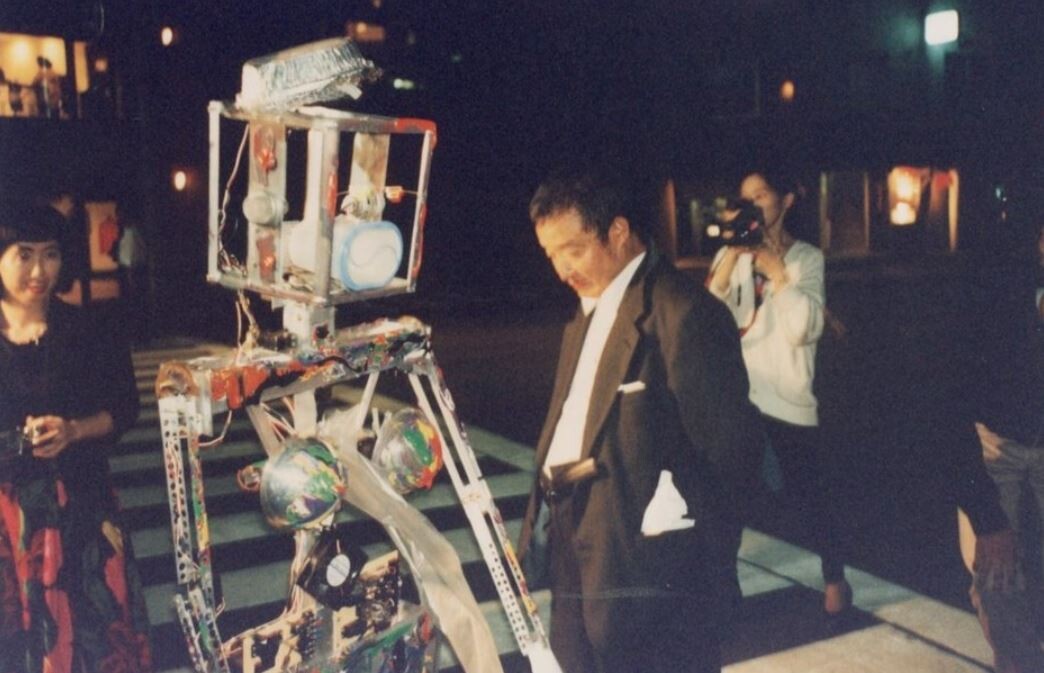
Nam June Paik, center, with his ″Robot K-456″ (1964) piece in Tokyo in this undated photo [NAM JUNE PAIK ART CENTER ARCHIVE]
Nam June Paik originally built the bipedal, remote-controlled robot in 1964 with Japanese engineer Shuya Abe, naming it after Mozart’s Piano Concerto No. 18 in B-flat major, K.456. For nearly two decades, the robot accompanied Paik to exhibition openings, captivating audiences with its awkward, labor-intensive movement.
Paik, who famously spoke of the “humanization of technology,” once joked that while robots were meant to reduce human labor, his robot required five technicians just to move for 10 minutes.
In 1982, Paik staged what he later called the “first catastrophe of the 21st century” during a retrospective at the Whitney Museum of American Art, orchestrating a mock traffic accident in which “Robot K-456” was struck by a car. The original robot is now housed in a German museum.
The Nam June Paik Art Center acquired a reassembled version created in 1996 and, using circuit diagrams donated by Abe, has since brought the robot back to operational condition. Korean media art collective SILO Lab restored the circuitry, while Kwon incorporated the revived robot into his new performance.
Designed to perform alongside people, “Robot K-456” now shares the stage with 14 other robots — a scenario Paik himself may never have imagined more than 60 years ago.
“This was both K-456’s first step and its first meeting with new friends,” Kwon said during rehearsals.
Unlike industrial humanoid robots developed for efficiency and labor, Kwon’s robots — much like Paik’s — are deliberately impractical.
“Robots that work like humans belong to engineers,” Kwon said. “My robots are fragile and awkward. But people seem to recognize something human in their unstable movements.”
Although robots have yet to roam city streets as Paik once imagined, the revival of “Robot K-456” has underscored how prescient his ideas were in an era when people increasingly form emotional relationships with robots and artificial intelligence.
Paik, a pioneer of video art, famously predicted a hyper-connected future in which everyone would become a media creator. Today, his once-playful robot is being reread not as a technological failure, but as a poetic commentary on the uneasy relationship between humans and machines — a relationship that continues to unfold.
SayArt.net Sharon Jung guhuijeong784@gmail.com
On a quiet winter afternoon in Yongin, Gyeonggi Province, a legendary robot has taken its first steps again after decades of silence. With its stiff, mechanical limbs and a silver foil hat, it appeared less like a vision of the future than a relic from an earlier era of science fiction.
Yet the robot carried a message.
“Robot K-456” (1964/1996), created by pioneering video artist Nam June Paik (1932–2006), was revived last month as part of a 50-minute multimedia performance at the Nam June Paik Art Center. The performance, staged in late January, marked the robot’s first public movement in decades and has since drawn renewed attention to Paik’s vision of technology and humanity.
“Robot K-456” (1964/1996) by Nam June Paik marches while scattering coffee beans at the Nam June Paik Art Center in Yongin, Gyeonggi, on Jan. 27. [KWON KEUN-YOUNG]
Titled “Ghost Theatre X Robot K-456: The Circuit Turned Back On,” the work was conceived by media artist Kwon Byung-jun and featured a cast of acrobatic robots performing alongside human operators. During the performance, robots unfolded fans, bowed in slow, meditative gestures, waved their arms in dance and tap-danced across a steel platform.
As the atmosphere reached its climax, a curtain styled as a massive cathode-ray tube television lifted to reveal the main act: “Robot K-456.”
Standing 1.85 meters tall, the human-sized robot gestured as if delivering a speech and lifted its foil-like hat while a speaker in its mouth blared a recording from U.S. President John F. Kennedy’s 1961 inauguration address: “Ask not what your country can do for you — ask what you can do for your country.”
Following the stage performance, Kwon and two technicians carried the robot to the museum entrance. From there, “Robot K-456” shuffled outdoors, scattering coffee beans and marching to the sound of a toy trumpet — its first steps since being restored.
Nam June Paik, center, with his ″Robot K-456″ (1964) piece in Tokyo in this undated photo [NAM JUNE PAIK ART CENTER ARCHIVE]
Nam June Paik originally built the bipedal, remote-controlled robot in 1964 with Japanese engineer Shuya Abe, naming it after Mozart’s Piano Concerto No. 18 in B-flat major, K.456. For nearly two decades, the robot accompanied Paik to exhibition openings, captivating audiences with its awkward, labor-intensive movement.
Paik, who famously spoke of the “humanization of technology,” once joked that while robots were meant to reduce human labor, his robot required five technicians just to move for 10 minutes.
In 1982, Paik staged what he later called the “first catastrophe of the 21st century” during a retrospective at the Whitney Museum of American Art, orchestrating a mock traffic accident in which “Robot K-456” was struck by a car. The original robot is now housed in a German museum.
The Nam June Paik Art Center acquired a reassembled version created in 1996 and, using circuit diagrams donated by Abe, has since brought the robot back to operational condition. Korean media art collective SILO Lab restored the circuitry, while Kwon incorporated the revived robot into his new performance.
Designed to perform alongside people, “Robot K-456” now shares the stage with 14 other robots — a scenario Paik himself may never have imagined more than 60 years ago.
“This was both K-456’s first step and its first meeting with new friends,” Kwon said during rehearsals.
Unlike industrial humanoid robots developed for efficiency and labor, Kwon’s robots — much like Paik’s — are deliberately impractical.
“Robots that work like humans belong to engineers,” Kwon said. “My robots are fragile and awkward. But people seem to recognize something human in their unstable movements.”
Although robots have yet to roam city streets as Paik once imagined, the revival of “Robot K-456” has underscored how prescient his ideas were in an era when people increasingly form emotional relationships with robots and artificial intelligence.
Paik, a pioneer of video art, famously predicted a hyper-connected future in which everyone would become a media creator. Today, his once-playful robot is being reread not as a technological failure, but as a poetic commentary on the uneasy relationship between humans and machines — a relationship that continues to unfold.
Warning: Trying to access array offset on value of type bool in /home/sayart/public_html/_libs/smarty/templates_c/103e99f6d7d08ee6b6541efd32c0ef2f33076acc_0.file.news_3t_view.tpl.php on line 56
Warning: Trying to access array offset on value of type bool in /home/sayart/public_html/_libs/smarty/templates_c/103e99f6d7d08ee6b6541efd32c0ef2f33076acc_0.file.news_3t_view.tpl.php on line 59