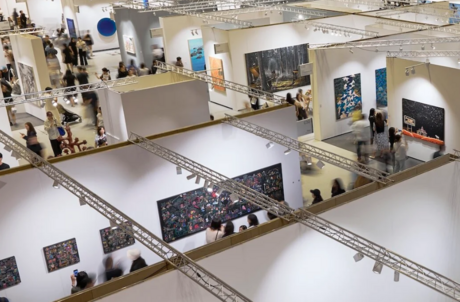



Artist Jennifer Packer has unveiled a powerful new exhibition that examines the complex nature of grief and memory through her latest collection of paintings. The show, titled "Dead Letter," is currently on display at Sikkema Molloy Jenkins gallery in New York's Chelsea district, featuring 21 works created in 2025 that demonstrate Packer's exceptional ability to capture the emotional weight of loss through delicate, translucent artwork.
Packer's artistic journey with themes of remembrance began long before the 2021 death of her partner, beloved poet April Freely. Her previous solo exhibition at the Whitney Museum, which opened just months after Freely's passing, included the powerful piece "Blessed Are Those Who Mourn (Breonna! Breonna!)," a tribute to Breonna Taylor, the young medical worker whose murder by police sparked worldwide Black Lives Matter protests in 2020 alongside George Floyd's death. Rather than depicting Taylor directly, Packer focused on a young man lying on a couch in an acid yellow interior, surrounded by seemingly insignificant objects that emerge from the surrounding atmosphere.
The artist's approach reflects what she describes as "the logic of a mind seizing on inconsequential things in the process of coming to terms with an overwhelming grief." Her tender portraits of friends have consistently balanced between unclear mark-making and stunning specificity, with faces that might be blurred and merged into monochrome backgrounds yet still rendered with an exactness that allows them to be fully and lovingly portrayed.
In "Dead Letter," Packer has refined her painting technique to what can be described as a delicate, razor-sharp edge that cuts deeply into questions about how people make their mark on the world and what traces remain after they're gone. In her artist's statement, she poses profound questions: "What might generous observation, precision of language, representational urgency, and space for error produce? What is it to witness and be recognized in ways that transform quality and clarity of life?"
This latest project represents a significant departure from simply processing the emotional aftermath of a loved one's death or creating memorials to someone's life. Instead, it functions as an investigation into how painting itself can adequately address the complex processes of seeing, feeling, and remembering.
One of the exhibition's standout pieces is "A.D.I.P.T.A. after Jay Electronica," a monumental work measuring 8 by 12 feet that manages to maintain an intimate atmosphere despite its large scale. Red dominates the composition, covering walls, furniture, and two figures - one standing on the left, another seated on the right - who appear caught in what Freely once referred to in her 2014 poem "But Is It an Essay, Voyager Edition" as "an impossible communication, but that's the only kind we want."
The standing figure holds her hand to her ear as if speaking on a telephone, even though the wall-mounted phone beside her remains unused. The seated figure has a telephone receiver attached to the side of her head with no hand holding it in place. The work's title references a tender song by American rapper Jay Electronica, suggesting that the frustrated desire to connect with others shapes our relationships both in life and death: "I got numbers in my phone that'll never ring again/ Cause Allah done called them home, so until we sing again."
The painting's mood draws heavily from Henri Matisse, most obviously referencing "The Red Studio." At the center of Packer's composition are two voids: the impossible communication between the figures and a dark blue form with a distinctively curved top that reads simultaneously as a window and the surface of a grand piano. These elements evoke Matisse's "Piano Lesson" (1916), which despite its musical subject matter possesses a strangely silent quality. Pianos appear in several other works in the exhibition, including "Warp, Weft" and "Anechoic Chamber."
Packer incorporates numerous art historical references throughout the exhibition. A pale blue dining chair transforms under prolonged viewing into one of Matisse's abstracted nudes, with the slope of shoulders, buttocks, head, and pubis articulated through Packer's delicate brushwork. A picture within a picture of ballerinas seems to reference Lynette Yiadom-Boakye or perhaps Noah Davis, another artist who, like Freely, died too young. Elsewhere, viewers can find a radically simplified, barely recognizable version of an Italian Renaissance lamentation of Christ.
In a particularly striking symbolic gesture, similar to how Catholic saints are depicted holding churches to symbolize their role in supporting Christian communities, Packer's seated figure balances a miniature suburban house on her fingertips. This imagery encompasses themes of pleasure, desire, home, care, loss, and the complex experience of knowing someone as much as - but no more than - they want to be known.
The entire exhibition carries the quality of a memento mori, serving as a reminder of life's fleeting nature, particularly through its many flower paintings. Packer has characterized this motif as representing funerary bouquets, serving as both a means of grounding herself in the studio and processing specific losses in her life. Bodies at rest are infused with anxiety about their inevitable passing, especially in works like "Innocent of Vanity," "The Pleasure of Being Ordinary," "Melt," and "Activity, The Pause," which closely resemble deathbed portraits.
In paintings featuring people playing piano, such as "Warp, Weft" and "Anechoic Chamber," standing figures place their hands on the musicians' shoulders in gestures of support that simultaneously recall death's gentle grip. Playing cards, long symbolizing life's fragility in art - whether arranged as a house of cards or shown as part of games representing chance and uncertainty - flutter like translucent leaves between the hands of a young man shuffling them in "Pacemaker."
Packer's painterly vocabulary of grief manifests through delicate, fragile lines that barely define tender parts of loved ones' bodies, such as feet rendered with stuttering care, as if the artist needs time to recall them. The translucency of her color washes allows bodies to melt into each other, creating impossibly thin membranes between where one ends and another begins. Her use of single colors knits together interior spaces, unifying different scales, degrees of description, and paint handling techniques, from broad abstract strokes to visible contours, and even incorporating collaged elements as seen in the exhibition's largest work, "The Edges of Longing Is an Impossible Communication (Dead Letter)."
This cohesion remains tenuous, similar to a dream's imposition of waking logic onto something that doesn't make rational sense. The exhibition's emotional and aesthetic impact proves so monumental that it demands complete attention, particularly relevant at a time when loss - of people, values, faith, and hope - seems omnipresent in contemporary experience.
"Jennifer Packer: Dead Letter" continues at Sikkema Molloy Jenkins, located at 530 West 22nd Street in Chelsea, New York, through December 13. The exhibition is organized by the gallery and represents a significant achievement in contemporary painting's engagement with themes of memory, loss, and human connection.