
Sayart.net - Milanese Artist Paolo Ventura Discusses Mixed-Media Photography and First Paris Exhibition

  • December 29, 2025 (Mon)

Milanese Artist Paolo Ventura Discusses Mixed-Media Photography and First Paris Exhibition

Sayart / Published December 29, 2025 03:32 PM
  • -
  • +
  • print

Paolo Ventura, a Milan-based visual artist, is preparing for his first solo exhibition in Paris at Galerie XII, where he will showcase his latest series titled Le Passe-Muraille. In a recent interview, Ventura opened up about his unconventional path to photography and his distinctive creative process that blends multiple artistic mediums. His journey began in the early 1980s when he studied painting, as photography schools were scarce and he felt more drawn to the traditional art world. After leaving art school, he found himself in Milan's booming fashion and advertising scene, which led to an unexpected career in fashion photography that lasted for years.

Ventura's approach to image-making has always been experimental and multi-layered. He explains that taking pictures was never the beginning but rather the final step in a lengthy creative process. For his Short Stories series created between 2012 and 2015, he painted theatrical backdrops where subjects could perform like actors on a stage. His War Souvenir series from 2005 featured photographs of puppets he crafted himself. More recently, Ventura has expanded his toolkit to include collage, painting, drawing, sculpture, and set design, creating rich, textured works that challenge traditional photography boundaries.

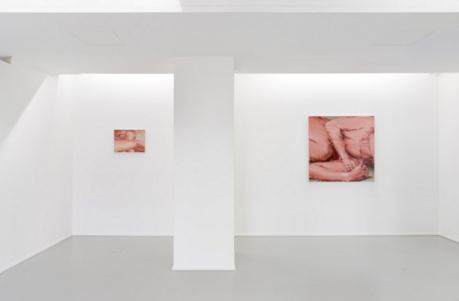
The Le Passe-Muraille series represents a new direction for Ventura, who completely transforms original photographs by painting over them to eliminate unwanted modern elements like cars, people, and signs. This process creates an entirely new setting that serves as his personal stage. He then inserts figures using collage techniques, often placing himself or family members into the scenes after carefully applying makeup and costumes to assume different identities. The series draws loose inspiration from Marcel Aymé's book of the same name, following a Parisian man who discovers he can walk through walls and uses this ability to peek into others' lives before growing bored with the lack of mystery.

Storytelling lies at the heart of Ventura's artistic instinct, though he remains uncertain about its exact origins. He notes that his father designed children's books and was an excellent storyteller, which likely influenced his narrative-driven approach. Ventura often writes short text pieces that evolve into visual series, as he did with Le Passe-Muraille, creating about ten text blocks that shaped the final images. His work consistently features a timeless quality, mixing different time periods so viewers cannot pinpoint when a scene is set, which enhances the dreamlike, sometimes surreal atmosphere while maintaining photography's connection to reality.

The artist's relationship with photography has evolved significantly over his career. Initially, he loved the medium's ability to capture reality and convey trust, wanting viewers to believe in his constructed scenes. However, he never identified solely as a photographer, finding the medium too flat and limiting. Twenty years ago, when he showed a publisher his unretouched World War II Italy maquette, he was told it wasn't photography because it didn't document something that actually happened. Ventura believes digital technology has since liberated photography, removing the obligation to be strictly real and allowing artists to explore new creative territories without traditional constraints.

Looking ahead, Ventura is preparing an exhibition in Minneapolis featuring a new project focused entirely on urban landscapes without any human figures. This work continues his practice of painting over photographs to remove all traces of life, shifting his focus to architectural design and the stark beauty of empty city spaces. The exhibition will mark another evolution in his career as he continues to push the boundaries between photography, painting, and storytelling, creating works that exist in their own timeless, imaginative realm.

Interview conducted by Zoé Isle de Beauchaine.

Paolo Ventura, a Milan-based visual artist, is preparing for his first solo exhibition in Paris at Galerie XII, where he will showcase his latest series titled Le Passe-Muraille. In a recent interview, Ventura opened up about his unconventional path to photography and his distinctive creative process that blends multiple artistic mediums. His journey began in the early 1980s when he studied painting, as photography schools were scarce and he felt more drawn to the traditional art world. After leaving art school, he found himself in Milan's booming fashion and advertising scene, which led to an unexpected career in fashion photography that lasted for years.

Ventura's approach to image-making has always been experimental and multi-layered. He explains that taking pictures was never the beginning but rather the final step in a lengthy creative process. For his Short Stories series created between 2012 and 2015, he painted theatrical backdrops where subjects could perform like actors on a stage. His War Souvenir series from 2005 featured photographs of puppets he crafted himself. More recently, Ventura has expanded his toolkit to include collage, painting, drawing, sculpture, and set design, creating rich, textured works that challenge traditional photography boundaries.

The Le Passe-Muraille series represents a new direction for Ventura, who completely transforms original photographs by painting over them to eliminate unwanted modern elements like cars, people, and signs. This process creates an entirely new setting that serves as his personal stage. He then inserts figures using collage techniques, often placing himself or family members into the scenes after carefully applying makeup and costumes to assume different identities. The series draws loose inspiration from Marcel Aymé's book of the same name, following a Parisian man who discovers he can walk through walls and uses this ability to peek into others' lives before growing bored with the lack of mystery.

Storytelling lies at the heart of Ventura's artistic instinct, though he remains uncertain about its exact origins. He notes that his father designed children's books and was an excellent storyteller, which likely influenced his narrative-driven approach. Ventura often writes short text pieces that evolve into visual series, as he did with Le Passe-Muraille, creating about ten text blocks that shaped the final images. His work consistently features a timeless quality, mixing different time periods so viewers cannot pinpoint when a scene is set, which enhances the dreamlike, sometimes surreal atmosphere while maintaining photography's connection to reality.

The artist's relationship with photography has evolved significantly over his career. Initially, he loved the medium's ability to capture reality and convey trust, wanting viewers to believe in his constructed scenes. However, he never identified solely as a photographer, finding the medium too flat and limiting. Twenty years ago, when he showed a publisher his unretouched World War II Italy maquette, he was told it wasn't photography because it didn't document something that actually happened. Ventura believes digital technology has since liberated photography, removing the obligation to be strictly real and allowing artists to explore new creative territories without traditional constraints.

Looking ahead, Ventura is preparing an exhibition in Minneapolis featuring a new project focused entirely on urban landscapes without any human figures. This work continues his practice of painting over photographs to remove all traces of life, shifting his focus to architectural design and the stark beauty of empty city spaces. The exhibition will mark another evolution in his career as he continues to push the boundaries between photography, painting, and storytelling, creating works that exist in their own timeless, imaginative realm.

Interview conducted by Zoé Isle de Beauchaine.
WEEKLY HOTISSUE