


Two couples who purchased a vacant five-story tenement at 676 Union Street in Brooklyn's Park Slope neighborhood for $100,000 in 1981 have listed their uniquely renovated building for $7.25 million. The property, which the artists transformed into two spacious duplex apartments with a shared ground-floor art studio, defies the typical prewar tenement layout that characterizes the surrounding blocks. Garrick Dolberg, a sculptor working in construction, and his partner Elisa Amoroso, a painter with architecture training from Cooper Union, collaborated with fellow artists Charles Powell and Diana Meckley-Powell to create the unconventional space. Their decades-long experiment in collaborative living and working has produced a 25-by-52-foot floor plan that maximizes natural light and open space. The building now stands as a testament to artist-led urban revitalization in an area once known for drug activity and arson-for-profit schemes.
The four artists connected in the early 1980s after New York City officials announced an abandoned building program for artists that ultimately never materialized. Inspired by the concept, Dolberg proposed that the couples pool their resources and undertake the project independently, with each contributing $50,000 in cash. They focused their search on Brooklyn after determining Manhattan properties were financially out of reach, eventually finding the vacant building on Union Street, then nicknamed a "mini-Amsterdam" for drug dealers. The neighborhood was filled with burned and vacant buildings, with landlords accused of torching properties for insurance payouts. Despite the risky location, the couples saw potential in the five-story structure's blank canvas and affordable price point.
The renovation process involved extensive hands-on labor from the artists themselves, who worked alongside hired crews to gut the building and implement their unconventional design. They relocated the central staircase to one side, creating expansive floor-through apartments that stretch the full 25-by-52-foot dimensions of the building. To save money, they stacked kitchens and bathrooms vertically while preserving load-bearing columns, and added skylights to the top floor for Powell's painting studio. Their hired architect frequently expressed skepticism about the plans, but Amoroso insisted on prioritizing space over conventional amenities, drawing on her childhood experience in a cramped Chicago three-family building. The couples received their certificate of occupancy in 1987 after years of ongoing construction.
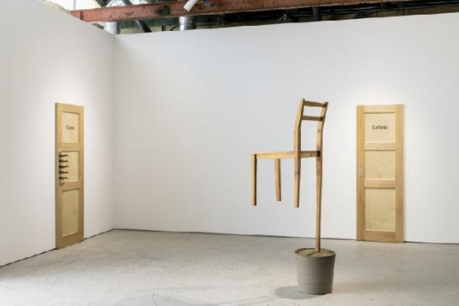
The ground floor became a shared 25-by-52-foot art gallery where anyone could create work or host impromptu exhibitions when potential buyers visited, including notable figures like playwright Edward Albee. The Metropolitan Museum of Art purchased one of Dolberg's sculptures, a brass form that reveals itself as a false front from certain angles. The couples maintained communal access to the roof deck and backyard, fostering a collaborative lifestyle that balanced privacy with creative community. Powell and Meckley-Powell raised their child in the upper duplex, while Dolberg pursued harpsichord building and Amoroso worked as a graphic designer for architecture firms. The building's generous square footage allowed them to accommodate extended family stays, with relatives sometimes visiting for as long as a year.
Now in their seventies, the artists have decided to sell the property that has defined their adult lives and artistic careers. Powell and Meckley-Powell moved out this fall, while Dolberg and Amoroso are considering relocating to Italy, where Amoroso holds citizenship. The $7.25 million listing price, marketed by Catherine Witherwax of Corcoran, reflects the building's unique character and prime Park Slope location, with monthly taxes of $1,167. The sale includes a backyard, roof deck, and floor-through unit, representing a remarkable return on a $100,000 investment made four decades ago. Their pioneering vision created not just a home, but a lasting architectural legacy that transformed a crime-ridden street into a multimillion-dollar destination.