
Sayart.net - Budapest Photographer Éva Szombat Explores the Endless Cycle of Nostalgia in New Exhibition and Photo Book

  • December 03, 2025 (Wed)

Budapest Photographer Éva Szombat Explores the Endless Cycle of Nostalgia in New Exhibition and Photo Book

Sayart / Published December 3, 2025 05:17 PM
  • -
  • +
  • print

Budapest-based photographer Éva Szombat has launched a provocative examination of contemporary society's obsession with the past through her new photo book and exhibition titled "Echo In Delirium." The project challenges the cyclical and seemingly absurd nature of nostalgia, particularly focusing on how younger generations romanticize eras they never experienced firsthand.

Szombat's inspiration for the project emerged in 2017 while teaching photography at the prestigious Moholy-Nagy University of Art and Design. She observed students on campus dressed in the same fashion styles their parents wore during the 1980s and 1990s. This observation led her to a profound realization about modern nostalgia: people who never lived through certain historical periods were developing passionate attachments to objects, clothing, and aesthetics from those times.

The conceptual foundation of "Echo In Delirium" rests on the idea of repetition and cultural recycling. "The point of the project is repetition," Szombat explains, "the idea that everything that surrounds us has already been experienced once, that what others treasure has already been our object of use, and that what once meant a lot is devoured by the institution of nostalgia and reproduced as a copy." Her work draws inspiration from theorists Jean Baudrillard and Mark Fisher, who described contemporary culture as eternally stuck in the present, unable to truly progress due to an overwhelming fascination with the past.

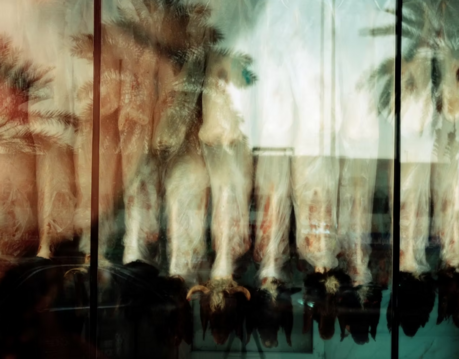
The photo book specifically examines object culture and design from the 1980s and 1990s, a particularly significant period when Eastern European countries transitioned from socialism to capitalism. Szombat's collection features an eclectic array of cultural ephemera captured in liminal spaces that seem to transcend time itself. Her subjects include a wax mannequin of a flexing Arnold Schwarzenegger, kitsch murals of Mr. Bean painted on wooden doors, chunky early computer equipment, and fading paintings of tropical beaches hanging alongside crumpled posters of Leonardo DiCaprio.

All photographs in the collection were shot using a small analog camera, creating images that deliberately embrace imperfection. When Szombat captured the red-eye effect in her subjects, she chose not to retouch these visual flaws, as they reminded her of the deteriorated images from past decades. This aesthetic choice reinforces the project's central theme about the chokehold that past cultural moments maintain on contemporary society.

Szombat attributes the current nostalgia phenomenon to broader societal challenges facing young people today. "Our society has been hit so hard recently, with the economic crisis, inflation, COVID, war in the neighborhood – young people find it hard to imagine the future," she observes. "Apparently it is much more comforting to look back to a past when everything was fine." However, she notes that this tendency toward nostalgic thinking is both self-reassuring and potentially deceptive, as people tend to remember selectively and idealize periods that weren't necessarily better than the present.

The book's physical design reinforces its conceptual message through a clever spiral spine that represents culture's never-ending cyclicality. The title itself references the Greek myth of Echo, a nymph cursed by the goddess Hera to only repeat the last words spoken by others. During her research and photography process, Szombat discovered that even people from her own millennial generation maintained strong attachments to objects from their youth, carefully preserving items like Tamagotchis, Polly Pocket toys, and Furbies.

The accompanying exhibition extends the project's impact beyond the printed page, creating an immersive environment that Szombat describes as "the spirit of the book jumped out into the room and continued to haunt modern spaces." She deliberately recreated wall patterns typically found in museums, though to most visitors, the aesthetic more closely resembles a grandmother's living room. Custom-made picture frames evoke graphics from past decades, while the exhibition space becomes a carefully curated collage incorporating photographer carpets, pinball machines, and curtains featuring printed toys and horror movie character Freddy Krueger.

This multimedia approach transforms "Echo In Delirium" from a simple photo book into what Szombat calls a "diptych" – a two-part artistic statement that contains the absurdity of the past within what she describes as "the babushka doll of the present." The project ultimately prompts viewers to question whether future generations will ever break free from the cycle of consuming nostalgia for cultural survival, or if humanity is destined to remain trapped in this endless loop of romanticizing previous eras while struggling to create genuinely new cultural moments.


Budapest-based photographer Éva Szombat has launched a provocative examination of contemporary society's obsession with the past through her new photo book and exhibition titled "Echo In Delirium." The project challenges the cyclical and seemingly absurd nature of nostalgia, particularly focusing on how younger generations romanticize eras they never experienced firsthand.

Szombat's inspiration for the project emerged in 2017 while teaching photography at the prestigious Moholy-Nagy University of Art and Design. She observed students on campus dressed in the same fashion styles their parents wore during the 1980s and 1990s. This observation led her to a profound realization about modern nostalgia: people who never lived through certain historical periods were developing passionate attachments to objects, clothing, and aesthetics from those times.

The conceptual foundation of "Echo In Delirium" rests on the idea of repetition and cultural recycling. "The point of the project is repetition," Szombat explains, "the idea that everything that surrounds us has already been experienced once, that what others treasure has already been our object of use, and that what once meant a lot is devoured by the institution of nostalgia and reproduced as a copy." Her work draws inspiration from theorists Jean Baudrillard and Mark Fisher, who described contemporary culture as eternally stuck in the present, unable to truly progress due to an overwhelming fascination with the past.

The photo book specifically examines object culture and design from the 1980s and 1990s, a particularly significant period when Eastern European countries transitioned from socialism to capitalism. Szombat's collection features an eclectic array of cultural ephemera captured in liminal spaces that seem to transcend time itself. Her subjects include a wax mannequin of a flexing Arnold Schwarzenegger, kitsch murals of Mr. Bean painted on wooden doors, chunky early computer equipment, and fading paintings of tropical beaches hanging alongside crumpled posters of Leonardo DiCaprio.

All photographs in the collection were shot using a small analog camera, creating images that deliberately embrace imperfection. When Szombat captured the red-eye effect in her subjects, she chose not to retouch these visual flaws, as they reminded her of the deteriorated images from past decades. This aesthetic choice reinforces the project's central theme about the chokehold that past cultural moments maintain on contemporary society.

Szombat attributes the current nostalgia phenomenon to broader societal challenges facing young people today. "Our society has been hit so hard recently, with the economic crisis, inflation, COVID, war in the neighborhood – young people find it hard to imagine the future," she observes. "Apparently it is much more comforting to look back to a past when everything was fine." However, she notes that this tendency toward nostalgic thinking is both self-reassuring and potentially deceptive, as people tend to remember selectively and idealize periods that weren't necessarily better than the present.

The book's physical design reinforces its conceptual message through a clever spiral spine that represents culture's never-ending cyclicality. The title itself references the Greek myth of Echo, a nymph cursed by the goddess Hera to only repeat the last words spoken by others. During her research and photography process, Szombat discovered that even people from her own millennial generation maintained strong attachments to objects from their youth, carefully preserving items like Tamagotchis, Polly Pocket toys, and Furbies.

The accompanying exhibition extends the project's impact beyond the printed page, creating an immersive environment that Szombat describes as "the spirit of the book jumped out into the room and continued to haunt modern spaces." She deliberately recreated wall patterns typically found in museums, though to most visitors, the aesthetic more closely resembles a grandmother's living room. Custom-made picture frames evoke graphics from past decades, while the exhibition space becomes a carefully curated collage incorporating photographer carpets, pinball machines, and curtains featuring printed toys and horror movie character Freddy Krueger.

This multimedia approach transforms "Echo In Delirium" from a simple photo book into what Szombat calls a "diptych" – a two-part artistic statement that contains the absurdity of the past within what she describes as "the babushka doll of the present." The project ultimately prompts viewers to question whether future generations will ever break free from the cycle of consuming nostalgia for cultural survival, or if humanity is destined to remain trapped in this endless loop of romanticizing previous eras while struggling to create genuinely new cultural moments.
WEEKLY HOTISSUE