


The House of Photography at Hamburg's Deichtorhallen is presenting the first comprehensive retrospective of French photographer Sarah Moon's work, offering an unprecedented survey of her artistic career. The exhibition, titled "Sarah Moon: Now and Then," features approximately 350 photographs and five films, allowing visitors to fully immerse themselves in the artist's distinctive visual world. Running through February 21, 2016, this landmark show represents a significant moment for both the institution and the artist, whose work has influenced generations of photographers since she began her career in the late 1960s.
Born in 1941, Sarah Moon spent her formative years between England and France, a cross-cultural upbringing that profoundly shaped her aesthetic sensibilities. Before establishing herself as a photographer, she worked as a model in Paris, gaining firsthand experience of the fashion industry's visual demands. This background proved invaluable when she picked up a camera in 1968 and adopted her professional name. Her early advertising campaigns for Cacharel quickly captured attention, leading to commissioned work for luxury brands such as Dior, Chanel, Comme des Garçons, Issey Miyake, and Valentino. Her editorial photography for major fashion magazines helped define a new visual language in fashion imagery.
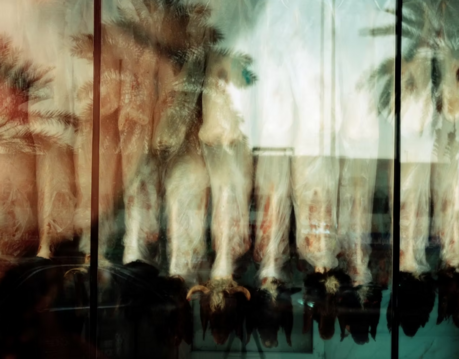
Exhibition curators Ingo Taubhorn and Brigitte Woischnik describe Moon's work as intentionally disorienting, pushing viewers out of comfortable spaces of ordered identity into realms of discord and difference. Her images deliberately blur time and space, creating ambiguous pictorial structures that challenge conventional composition. Moon frequently reduces sharpness, manipulates color values, and adds what curators call a "gray fog" to her processed photographs. These technical choices reflect her painterly and graphic imagination, transforming each image into what appears to be an emerging or fading memory, suspended between reality and dream.
Beyond her commercial fashion work, Moon has built a substantial body of personal artistic projects spanning both photography and film. She has directed short films and documentaries, including intimate portraits of her close friends Henri Cartier-Bresson and Lillian Bassman, two of photography's most influential figures. Her feature film "Mississipi One" demonstrates her ability to translate her visual aesthetic into cinematic language. Over decades, she has carefully developed an independent artistic practice that exists separately from her commissioned work, allowing her to explore themes of memory, myth, and timelessness.
The Hamburg exhibition thoughtfully combines portraits, still lifes of flowers, and views of both urban and rural environments, revealing the consistent threads that run through Moon's diverse practice. Her images, whether in soft-focus black-and-white or pale, muted colors, draw viewers into a realm of dreams and fairy tales while reflecting paradisiacal visions of unknown landscapes and enchanted cities. This unmistakable style has profoundly influenced the development of "mood photography," a genre that prioritizes atmosphere and emotional resonance over literal documentation.
Located at Deichtorstrasse 1-2 in Hamburg, the Deichtorhallen's House of Photography provides an ideal venue for this retrospective, with its dedicated spaces for lens-based art. The exhibition's arrangement allows visitors to trace the evolution of Moon's style while appreciating the technical and conceptual consistency of her vision. For photography enthusiasts, art historians, and general audiences, this retrospective offers a rare opportunity to experience the full scope of an artist who has consistently challenged photographic conventions. The show not only celebrates Moon's contributions to fashion photography but also secures her legacy within the broader canon of contemporary art, ensuring her influence will continue to shape visual culture for years to come.