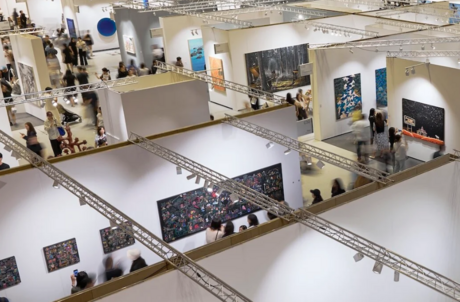



The emerging and mid-tier art markets demonstrated encouraging signs of recovery at this year's NADA and Untitled Art fairs in Miami, with steady sales and strong attendance marking a potential turnaround after a challenging period. Following November's robust $2.2 billion auction season, industry observers viewed Miami Art Week as the true test of market health, particularly for younger galleries and emerging artists.
Both satellite fairs opened their doors on Tuesday to packed crowds, creating a vibrant atmosphere that suggested renewed confidence in the market's foundation. While sales didn't reach the fever pitch of previous boom years when booths would sell out by noon, the consistent activity throughout opening day provided reassurance that this segment of the art world may finally be stabilizing.
"It isn't the same frenzy as a few years ago, but it is much stronger than earlier this year," art advisor Adam Green told ARTnews. The energy at Tuesday's openings built upon growing confidence that has been developing since strong performances at Frieze London and Art Basel Paris in October.
Maria Brito, another prominent advisor, echoed this sentiment, noting that "the market confidence is there from what I could see. Many of the things we inquired about today were sold." She added that her clients were actively purchasing works during the preview periods, indicating genuine collecting activity rather than speculative browsing.
The demographic composition of buyers reflected Miami's evolution as a collecting hub, with audiences appearing predominantly American and local, alongside notable participation from Latin American collectors. However, there was a noticeable absence of European buyers and virtually no Asian participation, highlighting the regional nature of this year's market activity.
Untitled Art emerged as the more internationally focused of the two fairs, featuring 157 exhibitors from more than 70 cities—a slight decrease from 2024's 171 participants. The fair's new executive director, Clara Andrade, has redesigned the layout to better highlight themed sectors, reimagining the event as both a gallery platform and broader cultural ecosystem.
Several galleries that traditionally participated in NADA made the switch to Untitled Art this year, reporting strong early sales. HairNails from Minneapolis and New York completely sold out their solo presentation of Emma Baetrez, with works priced between $5,000 and $9,000. Tribeca's Swivel Gallery paired Edgar Orlaineta's playful compositions with Ioanna Liminiou's hazy, synthetic works priced from $2,000 to $18,000, with the latter nearly selling out between booth inventory and gallery stock.
International galleries also found success at Untitled Art. London galleries Miro Presents, Rhodes, and Vigo all reported early sellouts, as did Spencer Brownstone from New York, SGR Galería from Bogotá, and Stems from Brussels. Brooklyn gallery Carvalho presented an all-women group show featuring Élise Peroi, Yulia Iosilzon, Rachel Mica Weiss, and Rosalind Tallmadge, with all works priced under $30,000.
Higher-tier activity remained robust, with Chicago dealer Kavi Gupta placing a Glenn Ligon work priced between $250,000 and $300,000. Carl Freedman Gallery from Margate, U.K., reported selling Lola Stong-Brett's "At Night I Sit and Beg For You" for $46,000 and Billy Childish's "man in buckskins" for $47,500.
Rajiv Menon Contemporary's thematic presentation "The Missing Figure," which reflected on absence and erasure across South Asian histories, sold five of six works priced between $6,000 and $10,000 within hours of opening. The successful reception demonstrated collectors' appetite for conceptually driven programming beyond pure aesthetic appeal.
JO-HS gallery, with locations in Mexico City and New York, captured immediate attention with Celeste's monumental pink field installation titled "Cosmos" (2025) in the Special Projects section. The work references Mexico's pink Cosmos flower, which blooms during rainy seasons and migrates naturally with water flows. The gallery also debuted a series by Rodrigo Echeverría, who reconfigures symbols from pre-Hispanic, Catholic, and ancient traditions into fractured existential narratives.
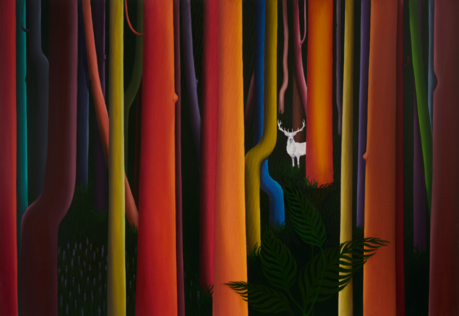
Digital and contemporary practices found strong reception as well. LatchKey Gallery presented Jessica Lichtenstein's richly layered digital forest cosmology works—created without generative AI—with $35,000 prints generating interest ahead of her Museum of Arts and Design exhibition in New York this May. Heft Gallery bridged digital fragmentation and classical materiality through Auriea Harvey's bronze and marble sculptures that blend ancient mythologies with contemporary forms.
NADA continued to serve its traditional role as a market-building platform for U.S. and Latin American galleries, particularly in the $5,000 to $20,000 range. Charles Moffett experienced one of the strongest openings with Kenny Rivero, selling ten new works priced between $12,000 and $25,000 ahead of the artist's first solo New York exhibition in three years.
Tara Downs completely sold out Yirui Fang's U.S. debut, with works priced from $6,000 to $16,000, ahead of a January solo show that is already nearly sold out. Mrs. gallery placed four works by Lily Ramírez at $10,000 each, two by Elizabeth Atterbury at $4,500 each, and two by Sachiko Akiyama at $12,000 each.
International participation at NADA also proved successful. Paris gallery Bremond Capela sold a Madeline Peckenpaugh painting to the Femmes Artistes du Musée de Mougins in France, along with multiple works by Alexis Soul-Gray and Valdrin Thaqi. Toronto's Patel Brown sold two works by Alexa Kumiko Hatanaka—whose work was popular at the Armory Show—and one by Sergio Suarez within the first thirty minutes of opening.
Sargent's Daughters offered one of the fair's most carefully curated presentations, mixing playful aesthetics from Wendy Red Star, Scott Csoke, and Debbie Lawson against Colefax and Fowler wallpaper. "Our departure from a traditional booth has been a hit," owner Allegra LaViola told ARTnews, noting multiple sales to both private and public collections.
ProxyCo presented a standout solo exhibition for Lucía Vidales, whose symbolically charged paintings evoke an intuitive space between figuration and abstraction. Inspired by dialogue with Mexican social realist David Alfaro Siqueiros, her eight-panel mural explored themes of collapse and spiritual transformation, reflecting contemporary existential instability. While smaller works priced between $8,000 and $12,000 sold quickly, the $60,000 mural—previously exhibited at the Kemper Museum of Contemporary Art and Ballroom Marfa—awaits institutional commitment.
The fairs also continued to surface compelling discoveries, including psychologically charged canvases by Kazakh artist Waldemar Zimbelmann at Amsterdam's Althuis Hofland, with all works priced under $20,000. In NADA's Projects section, Houston's Laura the Gallery reported early placements, particularly for Ernesto Solano's bronzes and Gutai artist Keiko Moriuchi's gold cosmology paintings, which attracted interest from local museums.
Overall, both fairs demonstrated that while the emerging and mid-tier markets haven't returned to previous peaks, they show clear signs of recovery. The steady sales activity, combined with strong curatorial programming and diverse international participation, suggests that this segment of the art world is finding sustainable footing after a difficult adjustment period. The focus on materiality, tactility, and ancestral mythologies provided grounding forces in an era of digital fragmentation and virtual reality, offering collectors tangible connections to artistic practice and cultural heritage.