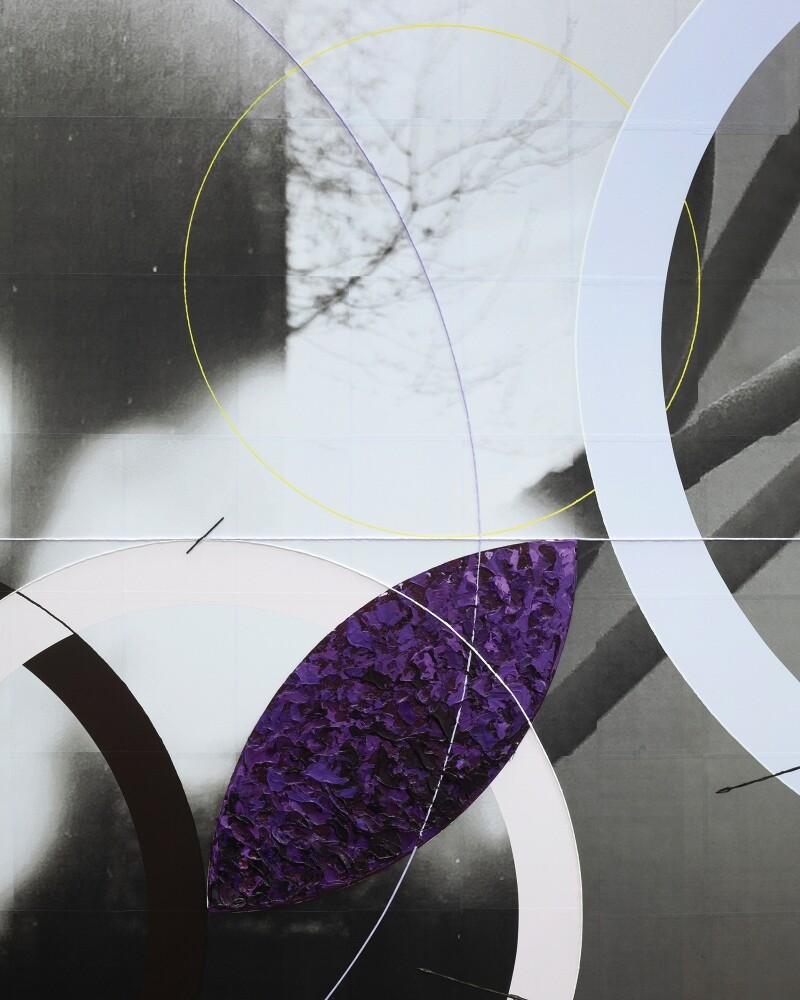
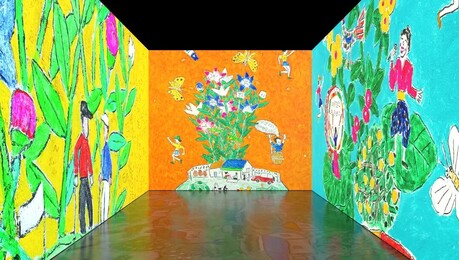
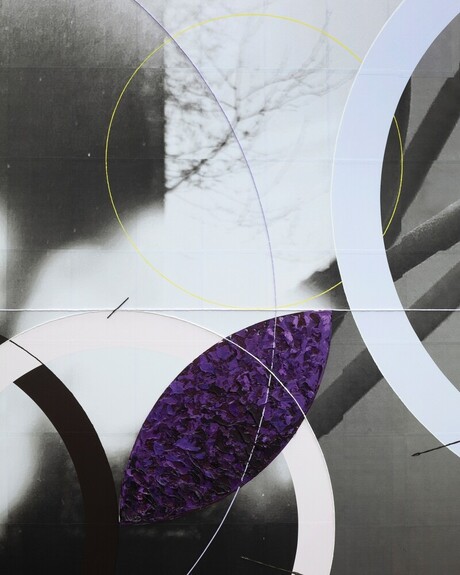
Exhibition image for Heejoon Lee’s “Stems and Nodes,” on view at Kukje Gallery in Seoul. Courtesy of Kukje Gallery.
The title of Heejoon Lee’s painting Myeongdong (2026) names a Seoul shopping district. The image that needs explaining is a mountain. Lee found it on a sportswear billboard there, according to Kukje Gallery’s account of his exhibition Stems and Nodes. Imagine the same painting titled after the peak. A viewer might try to identify a summit or a trail. With the title Lee gave it, the more interesting question is what a mountain was doing on that street in the first place.
A sportswear company has an obvious use for a mountain. It can put a shopper within imaginative reach of the outdoors while the shopper stands among stores. The advertisement depends on how readily the eye makes that trip. Lee gives the journey a return leg. Once we know where he found the image, looking at the mountain brings us back to Myeong-dong, to the shopfront and the commercial decision that put this particular piece of scenery in somebody’s path. An advertisement can be as specific a record of a neighborhood as a view down its main street.
Another painting in the exhibition starts with a route that Lee traveled repeatedly. After moving his studio, he began commuting along a wooded road in Taereung. The trees recalled Green Park in London, where he had spent time during a 2025 residency at the Delfina Foundation. In Julgi and Madi (2026), the Taereung path occupies the center of a large canvas. Images gathered elsewhere in Korea and in London extend to either side of it.
The detail worth lingering over is underfoot. Leaves collecting on the Taereung road in autumn prompted Lee to apply and stamp paint repeatedly, building a thick surface. The London park enters the picture through a remembered resemblance. Taereung gets to determine how the painting is made. That distinction gives the two places different weights, even when they occupy the same canvas. A list of the cities an artist has worked in would tell us very little about that difference.
Across the exhibition, Lee also draws on old paintings he encountered at the National Museum of Korea and textile patterns from London’s Victoria and Albert Museum. It is tempting to read those references as a guide to his influences. But the billboard poses a useful difficulty for that reading. A museum preserves an image so that people can come back to it. An advertiser buys space for an image until the campaign ends. Painting can give an image from either source a long second life. Remembering where Lee found each one keeps their different histories in view.
For a visitor to Stems and Nodes, there is a simple experiment worth trying: look at Myeongdong once before reading about the billboard, then look again. The mountain will have acquired a shop, a street and an intended customer without gaining a single brushstroke. Few accounts of how Seoul looks make quite so much room for what its residents see while they are on their way to do something else.
Heejoon Lee’s Stems and Nodes runs through January 31, 2027, in Kukje Gallery’s K1 and K2 buildings in Seoul.
SayArt.net Sayart sayart2022@gmail.com
In Heejoon Lee’s paintings, a mountain found in a Myeong-dong advertisement and fallen leaves on a Taereung commute offer two ways to picture the city.Exhibition image for Heejoon Lee’s “Stems and Nodes,” on view at Kukje Gallery in Seoul. Courtesy of Kukje Gallery.
The title of Heejoon Lee’s painting Myeongdong (2026) names a Seoul shopping district. The image that needs explaining is a mountain. Lee found it on a sportswear billboard there, according to Kukje Gallery’s account of his exhibition Stems and Nodes. Imagine the same painting titled after the peak. A viewer might try to identify a summit or a trail. With the title Lee gave it, the more interesting question is what a mountain was doing on that street in the first place.
A sportswear company has an obvious use for a mountain. It can put a shopper within imaginative reach of the outdoors while the shopper stands among stores. The advertisement depends on how readily the eye makes that trip. Lee gives the journey a return leg. Once we know where he found the image, looking at the mountain brings us back to Myeong-dong, to the shopfront and the commercial decision that put this particular piece of scenery in somebody’s path. An advertisement can be as specific a record of a neighborhood as a view down its main street.
Another painting in the exhibition starts with a route that Lee traveled repeatedly. After moving his studio, he began commuting along a wooded road in Taereung. The trees recalled Green Park in London, where he had spent time during a 2025 residency at the Delfina Foundation. In Julgi and Madi (2026), the Taereung path occupies the center of a large canvas. Images gathered elsewhere in Korea and in London extend to either side of it.
The detail worth lingering over is underfoot. Leaves collecting on the Taereung road in autumn prompted Lee to apply and stamp paint repeatedly, building a thick surface. The London park enters the picture through a remembered resemblance. Taereung gets to determine how the painting is made. That distinction gives the two places different weights, even when they occupy the same canvas. A list of the cities an artist has worked in would tell us very little about that difference.
Across the exhibition, Lee also draws on old paintings he encountered at the National Museum of Korea and textile patterns from London’s Victoria and Albert Museum. It is tempting to read those references as a guide to his influences. But the billboard poses a useful difficulty for that reading. A museum preserves an image so that people can come back to it. An advertiser buys space for an image until the campaign ends. Painting can give an image from either source a long second life. Remembering where Lee found each one keeps their different histories in view.
For a visitor to Stems and Nodes, there is a simple experiment worth trying: look at Myeongdong once before reading about the billboard, then look again. The mountain will have acquired a shop, a street and an intended customer without gaining a single brushstroke. Few accounts of how Seoul looks make quite so much room for what its residents see while they are on their way to do something else.
Heejoon Lee’s Stems and Nodes runs through January 31, 2027, in Kukje Gallery’s K1 and K2 buildings in Seoul.
Warning: Trying to access array offset on value of type bool in /home/sayart/public_html/_libs/smarty/templates_c/103e99f6d7d08ee6b6541efd32c0ef2f33076acc_0.file.news_3t_view.tpl.php on line 56
Warning: Trying to access array offset on value of type bool in /home/sayart/public_html/_libs/smarty/templates_c/103e99f6d7d08ee6b6541efd32c0ef2f33076acc_0.file.news_3t_view.tpl.php on line 59